Roof rat or pack rat?
Both live in Tucson, and the plan depends on which one you have.
Roof rats are slim and dark gray to black with a smooth, scaly tail longer than their body, and they live up high in trees, palms and attics.
Pack rats are stockier and brown with a furry tail and big ears, and they live in middens on the ground.
Roof rat droppings are about half an inch long with pointed ends; pack rat droppings are similar but are usually found in and around the midden. The inspection confirms which you have.
See pack rat removal if it turns out to be pack rats.
Where roof rats show up in Tucson
Roof rats are less widespread in Tucson than pack rats, but they do turn up, mostly in older neighborhoods with mature citrus, date palms, fan palms, oleander and bougainvillea hedges and alleys.
Midtown, Sam Hughes, the neighborhoods around the university and parts of the east side are typical.
What to look for near Oro Valley
- The time of year in Tucson changes the pressure, and rodents near Catalina Foothills are still confirmed at the window well.
- If you have seen rodents near Oro Valley, leave the soffit gap as you found it and photograph it.
- Pointed droppings in the attic, garage or along the top of walls
- Gnawing on wiring, irrigation lines, fruit and stored items
- Rats seen running along walls, fences or utility lines at dusk
How they get in
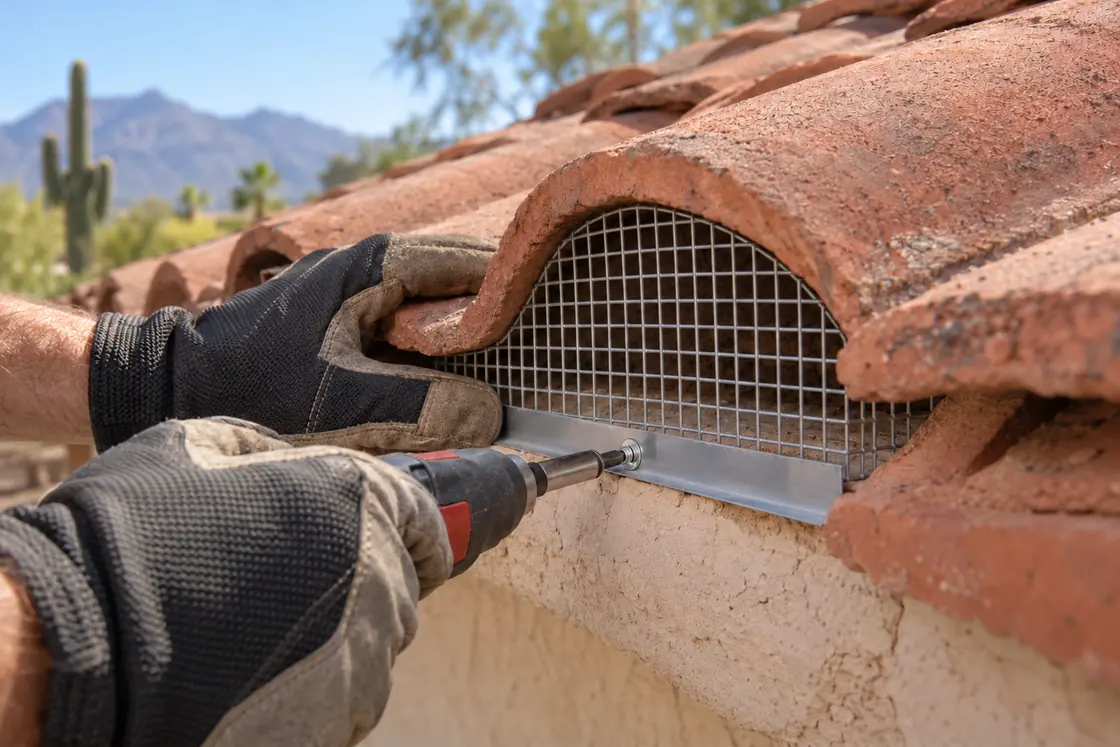
- Gaps under roof tiles at the eaves, where bird stops are missing
- Gaps where the roof meets a parapet, wall or addition
- Damaged or unscreened roof vents and evaporative cooler ducts
- Gaps around plumbing vents, AC line sets and solar panel conduit
- Trees, palms and vines touching the roof
If you have seen rodents near Sahuarita, leave the soffit gap as you found it and photograph it.
Inspection
Roofline, attic, garage, yard, trees and walls, looking for droppings, gnawing, runways and nests, and noting every gap.
Sealing
Gaps are sealed with materials rats cannot chew: bird stops and metal under tile eaves, hardware cloth on vents and cooler ducts, metal flashing at roof-to-wall gaps and steel mesh around lines and pipes.
Trapping
Traps go in the attic, along runways and in the garage. Roof rats are wary of new objects, so traps may be left unset for a few days first.
Trapping means the rats are removed rather than dying in walls.
Sequencing
If rats are inside, the last gaps are sealed in step with trapping so rats are not trapped in the house.
Follow-up
Return visits check and clear traps and confirm there is no new activity.
Flat roofs and parapets
Many Tucson homes, especially older adobe-style and Pueblo Revival homes and newer territorial styles, have flat roofs with parapet walls and canales that drain water off the roof.
Gaps where the roof membrane meets the parapet, around canales and at rooftop evaporative coolers are common roof rat entries. The technician checks these carefully, from the roof where it is safe.
If you have seen rodents near Marana, leave the gable vent as you found it and photograph it.
- Pick citrus as it ripens and pick up fallen fruit and dates
- If you have seen rodents near Marana, leave the gable vent as you found it and photograph it.
- Thin dense oleander and bougainvillea hedges where rats nest
- Store pet food and seed in sealed containers
- Do not leave pet water out overnight in summer
The rodents check in Tucson covers the block fence and the stored firewood on the same walk-through.
We do not scatter loose poison in attics, seal rats inside your home or call the job done before a follow-up.
Attic damage to check after
Once the rats are out, look at what they left behind.
Roof rats chew electrical wiring, the foil facing on ducts and the insulation around AC lines, and they flatten and soil blown-in insulation along their runways.
Torn ductwork in a Tucson attic means the AC is cooling the attic instead of the house.
The technician will point out what they see, so you can have an electrician or HVAC contractor look at anything that needs repair.
Cleanup
Clean droppings with gloves and disinfectant, letting it soak before wiping. Do not sweep or vacuum dry droppings. Heavily soiled attic insulation may need removal, quoted separately. Check attic wiring for gnaw damage.
Neighbors and alleys
Roof rats travel along walls and alleys from yard to yard. If neighbors have unpicked citrus and overgrown palms, pressure continues.
Coordinating fruit picking and tree trimming with neighbors, or through a neighborhood association, helps everyone.
What to look for near Marana
Call when you hear noises overhead, find hollowed fruit or see droppings. Call now.
Roof rat quick facts for Tucson
- Species: the roof rat, *Rattus rattus*, slender and dark with a tail longer than its body. It is a climber that lives in trees, attics and along rooflines.
- Food: citrus fruit, dates, pet food, bird seed, compost and garden vegetables.
- Signs: hollowed-out citrus still hanging on the tree, droppings in the attic or garage and scratching at night.
- Entry points: roof vents, parapet gaps on flat roofs, scuppers, AC line chases and gaps around garage doors.
- How it differs from a pack rat: roof rats have a long, scaly, nearly hairless tail and do not build stick middens.