Which mouse do you have?
House mice
Small, gray-brown, with a nearly hairless tail. They live close to people in kitchens, pantries, garages and wall voids, eating almost anything.
Deer mice
Slightly larger, with a white belly, white feet and a tail that is dark on top and white below. They prefer garages, sheds, casitas, cabins and storage rooms, especially near open desert.
Deer mice are the main carrier of hantavirus in Arizona, a rare but serious illness spread by breathing dust from their droppings and urine.
Cactus mice and others
Several other native mice live around Tucson and can wander into garages and storage near the desert edge. They are handled the same way.
When and why mice move in
Mice are present year-round, but many Tucson homes see more activity in fall and winter when nights cool, and after monsoon storms flood burrows.
Garages with bird seed, dog food, grass seed and stacked boxes are the usual starting point.
Where rodents show up near Vail
- Small dark droppings in the garage, pantry, drawers and storage
- Chewed bags of seed, pet food or pantry goods
- Nests of shredded paper, fabric or insulation in boxes, drawers or appliances
- Scratching in walls or cabinets at night
- Damage to stored items in casitas, sheds and garages
Where mice get in
- Gaps at the bottom and sides of garage doors
- The weep screed gap between stucco and slab
- Gaps around pipes, wires, AC lines and dryer vents
- Openings around evaporative cooler ducts
- Gaps under exterior doors without sweeps
For rodents in Tucson, the visit starts at the weep holes and then follows whatever that shows.
Inspection
Garage, kitchen, pantry, laundry, storage rooms, casitas and sheds, plus the outside walls. Droppings and nesting are mapped and every gap noted.
Sealing
Gaps are sealed with steel mesh, hardware cloth, metal flashing, door sweeps and garage door seals. Foam alone is not used.
Trapping
Snap traps go along walls and in the corners where mice travel. Traps inside let mice be removed rather than dying in walls. Locked bait stations may be used outside where appropriate.
Follow-up
Return visits check traps and look for new droppings until activity stops.
Safe cleanup and hantavirus
Hantavirus is spread by breathing dust from deer mouse droppings, urine and nesting.
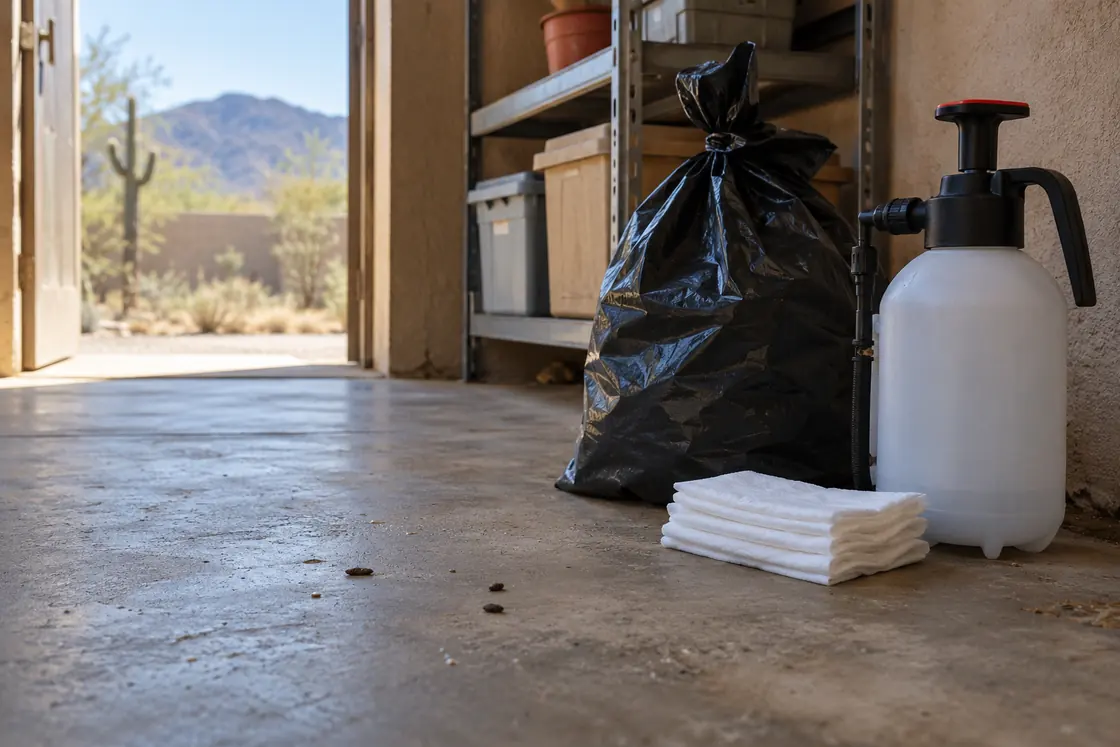
To clean up safely: - Open doors and windows to air the space out for 30 minutes before cleaning - Wear rubber or plastic gloves - Do not sweep or vacuum dry droppings or nests - Spray droppings and nests with a disinfectant or a bleach solution and let it soak for five minutes - Wipe up with paper towels, bag them and throw them out - Wash gloved hands, then remove gloves and wash hands again
For heavy contamination in sheds, casitas or attics, professional cleanup is safer. The technician will explain what is involved and quote it separately.
Garages, sheds and casitas
Many Tucson homes have casitas, guest houses, sheds and storage rooms that sit closed for weeks. Those are ideal mouse homes.
Store items in sealed plastic bins, keep feed in metal cans, keep doors sealed and check these spaces regularly.
In Tucson, rodents near Oro Valley are traced from the ridge vent, not from a product chosen before anyone looks.
Do not close up the stored firewood before the inspection for rodents in Tucson, or the useful evidence is gone.
Mice in appliances and cars
Mice nest in the warm, quiet spaces inside stoves, dishwashers, refrigerator bases and the engine bays and cabin air filters of cars.
A smell of urine when the heat or AC first runs in a car, or nesting material in the air filter, often means mice.
Traps near where the car is parked and sealing the garage handle most of it; the cabin filter should be replaced with gloves on.
Cabins on Mount Lemmon and in the mountains
Cabins and second homes up Mount Lemmon and in the surrounding mountains face deer mice and other rodents moving in while the cabin is empty.
Sealing before closing up, removing food, and careful cleanup when you open it again matter a lot. Ask whether your cabin is in range when you call.
Where rodents show up near Marana
Call at the first droppings, especially in a casita or shed where deer mice are likely. Call now.
Mouse quick facts for Tucson
- House mouse (*Mus musculus*): small and gray-brown, lives indoors and fits through a gap about 1/4 inch wide.
- Deer mouse (*Peromyscus maniculatus*): brown above and white below, with big eyes and ears; common in garages, casitas and cabins.
- Cactus mouse (*Peromyscus eremicus*): a desert mouse that sometimes enters homes on the desert edge.
- Hantavirus: in the Southwest, deer mice can carry Sin Nombre virus, the cause of hantavirus pulmonary syndrome, so droppings are wetted with disinfectant first and never swept dry.
- Signs: droppings in drawers and cabinets, chewed food packages, nesting in stored items and scratching at night.